Food For Your Brain

Topic

AI

What the models actually change in day to day work, separated from what vendors claim they change.

121 marks · first on 12 August 2026 · latest on 17 August 2026

Often filed alongside

searchengineland.com

LLM traffic converts differently — here's what to do about it

Proprietary data cited in the piece puts LLM referral traffic at a 20% conversion rate, 61% higher than paid search, with AI Mode queries running three times longer and often multimodal. Practical advice: optimize for "information gain" with original data and expert quotes, track citation patterns on frequently-cited sites, and rebuild attribution since click tracking under-counts AI referrals. One of the clearer pieces of evidence yet that GEO investment has a measurable commercial payoff, not just a visibility upside.

techcrunch.com

Anthropic CEO says AI backlash is 'fundamentally a crisis of trust'

Dario Amodei argues the public backlash against AI isn't about messaging balance but a broader trust deficit toward companies, governments and tech generally, and says aspirational claims like "AI will cure cancer" now read as cliche rather than credible. The framing travels well beyond AI: audiences increasingly discount promises and reward demonstrated delivery. A useful reference point when pressure-testing any AI-related brand narrative.

tubefilter.com

OnlyFans investor says it will "never use AI in any capacity to disrupt creators"

Architect Capital's James Sagan, who holds a 16% stake in OnlyFans, publicly committed to never using AI to disrupt the platform's creators, positioning AI instead as a fix for payment-processor and banking friction. The pledge lands as AI-generated "nudify" content and deepfakes increasingly threaten independent creators' livelihoods across platforms. Worth watching whether the commitment holds once investors start weighing AI-driven cost efficiencies against creator trust.

techcrunch.com

Anthropic shares more details about how Claude's new watermarks will work

Anthropic published technical detail on watermarking generated content, covering how the marking survives editing for both text and code. It lands alongside Spotify's AI Persona badges and YouTube's own labelling systems. Provenance marking is shipping across model providers and platforms at roughly the same time, so anything generated should be assumed detectable as generated.

techcrunch.com

Google lets users strip the visible watermark from its AI images

Gemini users can now remove the visible watermark from AI-generated images, while the invisible SynthID marker stays embedded. Google's position is that machine-readable provenance survives even when the human-readable signal disappears. That only holds if the receiving platform bothers to read it, which moves AI disclosure from something a viewer notices to something only a machine can verify.

tubefilter.com

YouTube wrongly labelled Kurzgesagt as AI-generated content

YouTube's automated systems flagged Kurzgesagt, one of the most established hand-animated education channels on the platform, as AI-generated, before reversing the decision. It is roughly the least plausible false positive available, which is exactly what makes it worth noting. Platforms are shipping AI-detection labels faster than the detection works, and the label lands on the channel before any human review.

digiday.com

European publishers are getting hit harder by AI bot scraping, report finds

A TollBit analysis shows European publishers face disproportionate AI scraping compared with North American sites, with robots.txt ignored more often. The disparity raises questions about why enforcement appears to differ by region despite stricter European rules on paper. Relevant to anyone weighing whether crawler policy actually protects content.

tubefilter.com

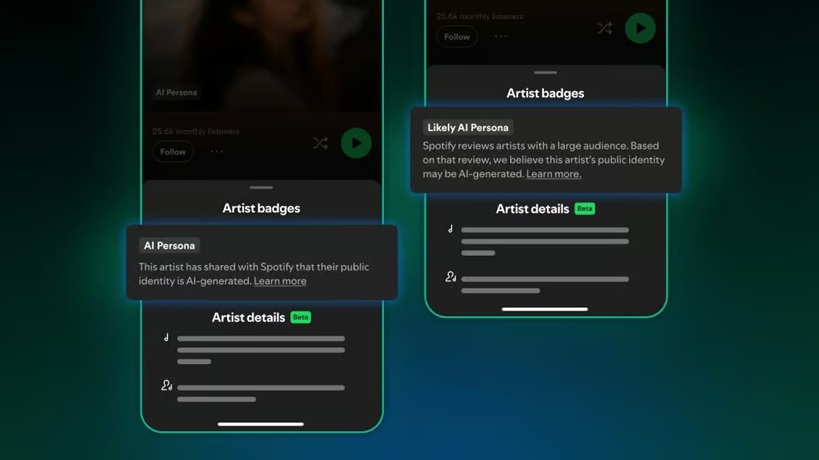
Spotify is cracking down on AI slop with AI Persona badges

Spotify will label AI-generated artist profiles and exclude them from recommendations, having removed 75 million spam tracks in a year. The badge marks the identity of the artist, not the production method: creators using AI tools stay recommendable if they own a recognised personal brand. It is a useful precedent for disclosure policy, since 'this account is not a person' is checkable while 'AI was used' is not.

tubefilter.com

Twitch auto-enrols all streamers in having their content scraped for Amazon LLM training

Twitch made scraping of streamer content for Amazon's LLM training the default, with opt-out rather than opt-in. CPO Mike Minton defended it bluntly: if it were opt-in, nobody would opt in. It raises a live question for creator contracts everywhere, since a usage grant covering brand amplification says nothing about the platform ingesting the same asset into a model.

socialmediatoday.com

YouTube expands access to its in-app AI chatbot

YouTube's conversational assistant is now available on desktop, mobile and TV, answering contextual questions about the video being watched. Viewers no longer need to go to the comments to ask. The consequence for anyone running community engagement is that comment volume becomes a weaker proxy for audience curiosity, since informational questions get absorbed upstream.

techcrunch.com

Facebook rolls out its standalone Creator Studio app with AI tools for creators

Meta has launched a dedicated Creator Studio app with AI assistance that suggests direction based on content performance, audience interaction and stated creator goals. The play is to keep creators inside Meta's own tooling rather than losing them to third parties. Platforms are now competing on creator workflow, not just distribution.

technologyreview.com

These startups are chasing the next big thing in LLMs

A wave of startups is building alternatives to the transformer, using sparse attention, retention mechanisms and diffusion approaches. The shared goal is cutting the compute cost of inference, with a secondary bet that new architectures enable reasoning that is not bound to language. Useful context for anyone assuming the current model shape is settled.

prnewsonline.com

AI is telling your story. Is it getting it right?

A former VP of Communications argues that brand narrative is now assembled by AI assistants out of third party sources, and that most comms teams have no visibility into what those assistants actually say. The piece treats answer accuracy as a communications responsibility rather than a search or IT problem. The cheap first move is simply to baseline what the major assistants currently answer.

thedrum.com

AI disclosure laws arrive in the EU and California. What do they mean for marketers?

New transparency rules in the EU and California require marketers to disclose AI-generated content, with the obligation landing on the brand rather than the production partner. The piece walks through what changes operationally during campaign development. In practice it moves compliance upstream into the brief, instead of leaving it to a legal review at the end.

fastcompany.com

Why do people actually prefer AI-generated stories to human writing?

A Cambridge University Press study found readers rated AI written stories as more engaging than human ones when the origin was hidden. Researchers point to a clearer, more direct style that reads as predictable and easy. Disclosure changes the judgement, which means fluency and credibility are separable and only the second survives contact with provenance.

adage.com

OpenAI's creator trip fallout, and what to check before signing an AI brand deal

The backlash against OpenAI's creator retreat is used to lay out the reputational exposure creators carry when partnering with AI companies. The concrete recommendation is deeper due diligence plus reciprocal morality clauses, so the creator is covered when the brand becomes the controversy. A clause structure that was always one directional is finally negotiable.

techcrunch.com

Reddit aims to make 'karma' less important for first-time posters with shift to AI moderation tools

Reddit is deploying stronger AI abuse-prevention systems so that accumulated reputation matters less when new members post. Platforms are shifting the cost of moderation from community gatekeeping to automated filtering, which changes who gets heard in a thread. Lowering the barrier to first-time participation raises comment volume, though not necessarily its quality.

Follow this the easy way.

The daily brief covers this topic and the four others, in one email each morning.

One email each morning, around 07:00 CET. Unsubscribe in one click. Your address is never sold, never shared.